Pendampingan Analisis Korelasi dan Regresi Linier Berganda Menggunakan JASP serta Interpretasi Berbasis DeepSeek dan ChatGPT
Keywords:
Analisis Korelasi, Regresi Linier Berganda, Software JASP, Interpretasi Berbasis AIAbstract
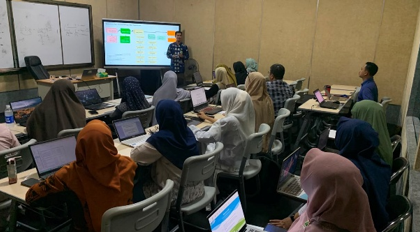
Correlation and multiple linear regression analyses require an understanding of statistical concepts and the ability to accurately interpret the resulting output. The use of JASP, ChatGPT, and DeepSeek offers a supportive alternative to help academics understand statistical results and develop them into scholarly narratives. This activity aims to enhance the ability of lecturers to conduct correlation and multiple linear regression analyses using JASP and to interpret the output with the assistance of ChatGPT and DeepSeek. The participants comprised 23 lecturers from various faculties at Universitas Muhammadiyah Mataram, holding academic ranks ranging from junior lecturer and expert assistant to lecturer. The activity methodology included presentations on hypothesis testing concepts, prerequisite tests, and classical assumption tests; hands-on analysis using JASP; and exercises in describing and interpreting output via ChatGPT and DeepSeek. Evaluation was conducted using a seven-indicator Likert scale questionnaire, with responses converted to a 100-point scale. The evaluation results showed participant response rates ranging from 82.35% to 89.41%, indicating a positive reception regarding the use of JASP and AI to support statistical interpretation.
References
Ansari, A. N., Ahmad, S., & Bhutta, S. M. (2024). Mapping the global evidence around the use of ChatGPT in higher education: A systematic scoping review. Education and Information Technologies, 29(9), 11281–11321. https://doi.org/10.1007/s10639-023-12223-4
Arti, S., & Suherlan, E. (2025). Evaluasi kinerja machine learning dalam memprediksi kemampuan adaptasi mahasiswa pada lingkungan pembelajaran daring. Jurnal Pustaka AI (Pusat Akses Kajian Teknologi Artificial Intelligence), 5(1), 50–57. https://doi.org/10.55382/jurnalpustakaai.v5i1.901
Burkhardt, S., & Rieder, B. (2024). Foundation models are platform models: Prompting and the political economy of AI. Big Data & Society, 11(2), 20539517241247840.
Erlena, M. D. (2025). Langkah awal menuju pemrograman. Maliki Interdisciplinary Journal, 3(11), 117–130. Diakses dari https://urj.uin-malang.ac.id/index.php/mij/article/view/18633
Fajarudin, A. A. (2025). Model pembelajaran bahasa Arab pada era kecanggihan artificial intelligence di MTs KHA Wahid Hasyim Bangil. Ashlach: Journal of Islamic Education, 3(1), 77–86. https://doi.org/10.55757/ashlach.v3i1.979
Ghazali, M., Zohri, M., Lestari, J., Purnamasari, R., & Fitriati, I. (2023). Transformasi kemampuan analisis statistik mahasiswa UIN Mataram melalui pelatihan software JASP. ABSYARA: Jurnal Pengabdian pada Masyarakat, 4(2), 235–247. https://doi.org/10.29408/ab.v4i2.22540
Handayani, A. A., Supatminingsih, T., Ahmad, M. I. S., Ismail, I., & Istiqamah, S. H. N. (2026). Pendampingan JASP pada mata kuliah statistik bagi mahasiswa Pendidikan Ekonomi Universitas Negeri Makassar. Jurnal Sulapa Eppa’, 2(1), 106–112. Diakses dari https://journal.unm.ac.id/index.php/JSE/article/view/12990
Hartmann, M., Du, H., Feldhus, N., Kruijff-Korbayová, I., & Sonntag, D. (2022). XAINES: Explaining AI with narratives. KI-Künstliche Intelligenz, 36(3), 287–296. https://doi.org/10.1007/s13218-022-00780-8
Hernández-Orallo, J. (2017). Evaluation in artificial intelligence: From task-oriented to ability-oriented measurement. Artificial Intelligence Review, 48(3), 397–447. https://doi.org/10.1007/s10462-016-9505-7
Hidayah, S. F., Miftah, M., Werdhiana, I. K., & Gustina, G. (2026). Analisis komparatif kualitas umpan balik ChatGPT dan DeepSeek terhadap jawaban kontekstual siswa pada konsep optik fisika. Al-Irsyad Journal of Physics Education, 5(2), 168–177. https://doi.org/10.58917/ijpe.v5i2.839
Ishak, S., Wajdi, F., Syawal, S., Sulolipu, A. A., & Ram, S. W. (2026). Pelatihan penggunaan aplikasi JASP untuk meningkatkan kemampuan analisis data bagi guru di Kabupaten Kepulauan Selayar. Jurnal Sulapa Eppa’, 2(1), 16–22. Diakses dari https://journal.unm.ac.id/index.php/JSE/article/view/12280
Jariah, A., & Mufarrohah, H. (2025). Penerapan probabilitas Bayes dalam pengambilan keputusan akademik siswa. AL-BAHTS: Jurnal Ilmu Sosial, Politik, dan Hukum, 2(3), 28–40. https://doi.org/10.32520/albahts.v2i3.5017
Jihadillah, M. (2025). Mengembangkan kerangka kerja literasi kecerdasan artifisial (AI) untuk masyarakat umum: Sebuah model pengabdian edukatif di era disrupsi digital. SWARNA: Jurnal Pengabdian kepada Masyarakat, 4(5), 858–869. https://doi.org/10.55681/swarna.v4i5.1757
Nair, S., Rasul, T., Arpaci, I., Saadouli, N., Ladeira, W. J., & de Oliveira Santini, F. (2026). ChatGPT and DeepSeek in higher education: Comparing two contrasting generative AI models and their implications for student learning. Journal of Applied Learning & Teaching, 9(2), 1–22. https://doi.org/10.37074/jalt.2026.9.2.5
Nasir, A. M., & Hatibu, H. (2026). Pembelajaran statistika berbasis PJBL dan JASP: Persepsi mahasiswa dan implikasinya terhadap hasil belajar. ELIPS: Jurnal Pendidikan Matematika, 7(1), 1–13. Diakses dari https://journal.unpacti.ac.id/index.php/ELIPS/article/view/2566
Niu, G., Segall, R. S., Zhao, Z., & Wu, Z. (2021). A survey of open source statistical software (OSSS) and their data processing functionalities. International Journal of Open Source Software and Processes (IJOSSP), 12(1), 1–20. https://doi.org/10.4018/IJOSSP.2021010101
Rasul, T., Nair, S., Kalendra, D., Robin, M., de Oliveira Santini, F., Ladeira, W., . . . Heathcote, L. (2023). The role of ChatGPT in higher education: Benefits, challenges, and future research directions. Journal of Applied Learning & Teaching, 6(1), 41–56. Diakses dari https://search.informit.org/doi/abs/10.3316/informit.T2025102700000390990155131
Ruta, M. R., Gaidici, T., Irwin, C., & Lifshitz, J. (2025). ChatGPT for univariate statistics: Validation of AI-assisted data analysis in healthcare research. Journal of Medical Internet Research, 27, e63550. https://doi.org/10.2196/63550
Saharuddin, S., Dahlan, H., & Kainta, E. (2026). Sosialisasi Jeffreys’s Amazing Statistics Program (JASP): Analisis statistik praktis bagi mahasiswa. Jurnal Masyarakat Madani Indonesia, 5(2), 1018–1025. https://doi.org/10.59025/3s50ar68
Sianipar, D. S., Tarigan, D. E. P., & Pasyah, G. (2026). Analisis ketergantungan mahasiswa terhadap penggunaan AI tools dengan pendekatan statistik deskriptif. Journal of Intelligent Computing and Advanced Data Science, 1(1), 27–38. Diakses dari https://jurnal.satyaterrabhinneka.ac.id/index.php/icoscience/article/view/92
Subekti, R., Insani, N., Brilliant, I. I., Sari, E. R., Saptaningtyas, F. Y., & Bayyinah, N. (2026). Sosialisasi JASP: Pelatihan analisis data statistik bagi akademisi Makasar. Jurnal AbdiMas Nusa Mandiri, 8(2), 251–258. https://doi.org/10.33480/abdimas.v8i2.7813
Suharmawan, W. (2026). Prompt engineering sebagai kompetensi kunci dalam mengoptimalkan kinerja generative AI di era transformasi digital. Jurnal IKA PGSD (Ikatan Alumni PGSD) UNARS, 17(1), 290–297. https://doi.org/10.36841/pgsdunars.v17i1.8803
Tompunu, K. A., Demetria, P., Kinanty, R. S., & Fathoni, F. (2025). ChatGPT sebagai alat bantu pencarian referensi: Analisis penggunaan oleh mahasiswa sistem informasi UNSRI dalam menyusun tugas akhir. JATI (Jurnal Mahasiswa Teknik Informatika), 9(4), 6346–6353. https://doi.org/10.36040/jati.v9i4.14062
Tricahyo, F., & Zulfiningrum, R. (2025). Human-machine communication dalam interaksi penggunaan AI. Professional: Jurnal Komunikasi dan Administrasi Publik, 12(1), 83–92. https://doi.org/10.37676/professional.v12i1.7755
Wang, P. Y., Liu, T. S., Wang, C., Li, Z., Wang, Y., Yan, S., . . . Yu, Y. (2026). A survey on large language models for mathematical reasoning. ACM Computing Surveys, 58(8), 1–35. https://doi.org/10.1145/3786333
Downloads
Published
Issue
Section
License
Copyright (c) 2026 Syaharuddin Syaharuddin, Earlyna Sinthia Dewi, Erni Romansyah, Novi Yanti Sandra Dewi, Zaenafi Ariani, Ahmad Hulaimi, M. Anugrah Arifin

This work is licensed under a Creative Commons Attribution-NonCommercial-NoDerivatives 4.0 International License.